
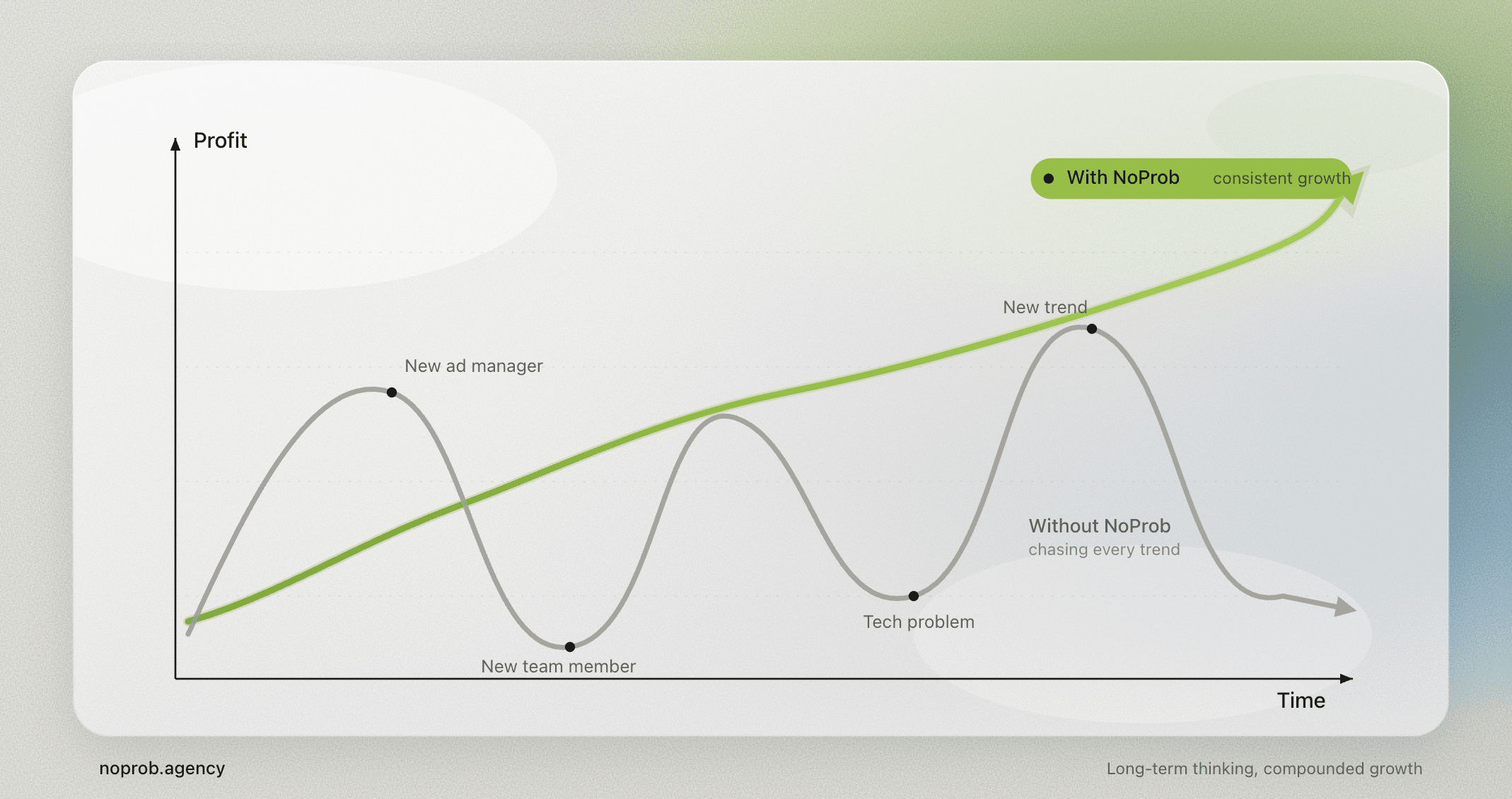
I've worked with fashion, retail, and DTC brands across Italy and Europe for over seven years. I've seen two types of founders.
The first one changes every 6-12 months: new ads agency, new developer, new platform, a new "strategy" pulled from a LinkedIn post. Looks dynamic. In reality, they are resetting their business every quarter.
The second one is the quiet one. Keeps the same team, the same platform, the same plan for years. Optimizes small things every week. Isn't on social media talking about growth hacks. But when you look at the numbers, the business is growing consistently and predictably.
A working eCommerce strategy isn't the one chasing every new thing. It's the one building foundations that hold for years and adapting on top without breaking what works.
I say this because I see it in my clients' data. And because serious research from McKinsey, Bain, and SHRM confirms it. Real numbers, not slogans.
In this article:
- How much trend chasing really costs (and why you don't see it on the P&L)
- What the data says about companies that think long-term
- Why a stable customer is worth 3-5x a new purchase
- The 4 foundations of a long-term eCommerce strategy that works
- A real case: 4 years of technical partnership with an Italian fashion brand
If you run a structured B2C brand and you want to stop hearing about a new "revolutionary framework" every month, keep reading.
The Real Problem: Trend Chasing Has a Hidden Cost
Every time a brand changes ad manager, developer, platform, or tech stack without a structural reason, it pays a price that rarely shows up on the income statement.
Here are the real numbers.
Replacing a single employee costs between 50% and 200% of annual salary (SHRM, Society for Human Resource Management). For specialized technical roles the figure rises to 100-150%. For executive roles it reaches 213% (Center for American Progress).
In practice: replacing a €60,000 senior developer can cost the brand between €60,000 and €120,000 across recruiting, onboarding, training, lost productivity, and knowledge walking out the door.
It's not just the hire. It's the time-to-ramp-up. A new team member reaches full operational capacity in 3-6 months (SHRM). For those months the role is structurally underperforming. If you swap 2 key roles in a year, you've lost a full quarter of operational capacity.
And what about tracking, processes, brand knowledge?
A new developer doesn't know why certain pixels were set up the way they are. A new media buyer doesn't know which campaign angles historically perform on your target. A new strategist has to learn the brand positioning from scratch. Every change resets the context.
This is the cost you do not see on the P&L. It is called "loss of institutional knowledge" and according to SHRM it represents 60-70% of the real turnover cost. Almost nobody measures it.
When you multiply this by continuous platform changes, agency changes, tech stack changes, the problem compounds. After 18 months of "continuous optimization through changes" you have an eCommerce performing worse than when you started, and you do not really know why.
The numbers tell you this: every unnecessary change is burned capital. The right question is not "how do I find someone who does better". It is "how do I make sure the people who are working keep working and improving".
What the Data Says About Long-Term Thinking Companies
In 2017 the McKinsey Global Institute published a study that quantified for the first time the economic impact of long-term thinking. They analyzed 615 US large and mid-cap public companies over 2001-2015. They built a Corporate Horizon Index based on five factors: investment patterns, earnings quality, earnings management, growth, ROIC.
The results, after 13-14 years of observation.
The long-term focused companies (164 in the sample) had:
- Cumulative revenue growth 47% higher than the short-term ones
- Cumulative earnings growth 36% higher
- Economic profit growth 81% higher
- 12,000 more jobs created on average
This isn't marketing. It's a real dataset of 615 companies tracked over 13 years, picked up by Harvard Business Review and Fortune.
For a B2C eCommerce the proportions are obviously different. But the principle scales: a brand that changes direction every quarter never builds a defensible advantage. A brand that keeps platform, team, and core processes for years (optimizing on top incrementally) accumulates a compound advantage that becomes very hard to copy.
I see this myself in the projects I run. When I help a client reduce non-structural changes and focus on weekly improvements (speed, conversion rate, accurate tracking, user experience), the numbers become more stable and predictable. No more "spike and collapse", just a rising curve.
There's another point McKinsey makes well: long-term companies keep investing even during crises. While short-term ones cut R&D at the first sign of trouble, long-term ones maintain or increase. Result: in the post-financial-crisis period 2007-2014, long-term companies grew R&D by 8.5% annualized versus 3.7% for short-term ones.
Translated to eCommerce: those who kept optimizing tracking, performance, and checkout during the post-iOS 14 slowdown (when everyone else was cutting) find themselves today with a technical infrastructure years ahead of competitors.
Trend chasing presents itself as dynamism. It's just reactivity. Real eCommerce strategy is the ability to hold the course when the market wobbles.
Why Stable Customers Are Worth More Than Unpredictable Sales
Frederick Reichheld's study (Bain & Company, the creator of the Net Promoter Score) demonstrated something counterintuitive: increasing customer retention by 5% generates a profit increase between 25% and 95% (Bain, "The Loyalty Effect").
The range is wide because it depends on the sector. In fashion and subscription-friendly products (supplements, beauty, food) the retention value sits toward the top of this range.
The reasons are simple:
- Acquiring a new customer costs 5-25 times more than retaining an existing one (Harvard Business Review)
- The probability of converting an existing customer is 60-70%; converting a new prospect is 5-20% (Marketing Metrics)
- Existing customers spend on average 31% more than new ones (Invesp)
- Returning customers are 9x more likely to convert than new visitors (Adobe Digital Index)
For an eCommerce this translates to a simple truth: margin isn't made on the first purchase, it's made from the second onward.
Yet most founders spend 90% of their marketing budget on acquisition. Half of that could go to retention (email marketing, loyalty programs, post-purchase customer experience, recurring products), generating significantly higher ROI.
And here we come back to long-term thinking: retention isn't something built in a quarterly campaign. It requires months of consistent optimization, of automation flows tested and refined, of continuous customer segment analysis. If every 6 months you change email marketer and start from zero, you'll never build a serious retention program.
A predictable brand is worth more than an "explosive" brand. For investors, for acquirers, and above all for whoever runs it. Predictability is what lets you plan, hire, invest in quality instead of firefighting.
The Foundations of a Long-Term eCommerce Strategy
Trend chasing is defeated with a solid eCommerce strategy built on four foundations, in priority order.
1. Stabilize the technical core
The platform is the literal foundation. Changing it every 2-3 years is the fastest way to reset years of optimization. The rule I give my clients: pick a serious platform (for structured B2C, Shopify remains the most rational choice) and don't change it for at least 5 years.
This doesn't mean accepting limitations. It means investing energy into optimizing the existing setup (performance, conversion rate, mobile UX) instead of migrating every 18 months. For a complete view on why Shopify is the most rational choice for structured B2C brands, read our practitioner's guide to how Shopify works.
At noprob.agency we built the Data-Driven Team precisely for this: a stable technical team that handles the platform, optimizations, tracking, and emergencies on an ongoing basis. Not an external vendor that rotates, but an extension of your in-house team.
2. Clean tracking and reliable KPI dashboards
You can't optimize what you don't measure. And most eCommerce stores have partial or broken tracking, especially after iOS 14 and the end of third-party cookies.
The essential eCommerce KPIs to monitor every week are few: AOV (Average Order Value), conversion rate by traffic source, retention rate, checkout drop-off, margin per product. Not 30 metrics. The 5-6 that actually move the business.
When tracking is dirty, every downstream decision is an opinion dressed as data. Investing in a serious server-side tracking setup (Google Analytics 4, Meta Conversions API, GTM) is one of the few investments that pays back in 6 months of better-optimized campaigns.
3. Stable team (in-house or external, what matters is continuity)
It doesn't matter if your team is in-house or external. What matters is that the people are the same for years. A media buyer who has run your ads for 3 years knows the campaign angles, the audiences that work, the peak periods for your audience. A new media buyer starts from zero and costs you 3-6 months of ramp-up.
For many structured B2C brands the best model is a dedicated external team. It costs less than a complete in-house team and is more stable than a freelancer who moves on to other projects. The key is choosing a partner who works to build a long relationship, not to close a project and move on.
4. Roadmap based on real problems, not trends
Every quarter founders are bombarded with new industry "must-haves": new social channel, new automation platform, new growth framework. 90% are distractions.
A serious eCommerce roadmap starts from the real problems of the business: where do you lose conversions? Which funnel step has the highest drop-off? Where are your lowest margins? From there you identify 2-3 quarterly priorities and work on them in a focused way.
Everything else is noise.
A Real Case: 4 Years of Technical Partnership
To give context to all this, a real case from the brands we work with.
An Italian luxury fashion brand (multibrand boutique, physical and online presence). Physical stores and an online store. When we took them on in 2022, they were on an Italian platform with integrated ERP: rigid, slow, not scalable.
In 4 years of continuous partnership:
- Migration to Shopify in May 2025, connected to the stores proprietary ERP
- Full server-side tracking (audit score 92/100)
- Same partner and the same direction for all 4 years
- Online sales in the 12 months after the migration: +67.7% on the 12 months before
- Orders: +49.4%, average order value: +12.2% in the same comparison
- Six figure months: one before Shopify, four after
What happened isn't magic. It's consistency. Same team, same methodology, for 4 years. While other brands keep changing agencies and complaining about flat growth, they were accumulating optimizations that compounded.
If you want to see the full case (initial challenge, technical approach, KPIs broken down by year), we wrote a dedicated use case in our case studies.
I don't tell this as marketing. I tell it because it's concrete proof of what I wrote above: long-term thinking in eCommerce isn't theory, it's the factor that makes the difference between brands that grow and brands that go in circles.
FAQ: The Questions I Get Asked Most
If I stick to the same strategy, won't I fall behind while competitors innovate?
No, because "keeping the strategy" does not mean "not changing anything". It means keeping the foundations stable (platform, core team, processes) and iterating on top continuously. Competitors who change everything every quarter are burning energy, not building competitive advantage.
How long before I see results with a long-term approach?
The first measurable improvements arrive in 3-6 months on tactical KPIs like conversion rate, AOV, and retention. Structural results on total revenue require 12-18 months. It's slower than viral tricks, but it compounds: each month that passes the advantage grows, it does not reset.
How do I tell if I'm paying a hidden cost from constant changes in my eCommerce?
Make this list: in the last 12 months, how many times did you change core team members, platform, ad strategy, tracking setup, agency? If you changed more than 2 things, you're paying a cost you probably don't see on the P&L but that exists.
Does a long-term eCommerce strategy cost more than a short-term one?
In the short term it seems to cost the same. In the long term it costs much less. Continuous changes generate recurring costs of onboarding, ramp-up, and knowledge loss that you never see aggregated on the balance sheet. Keeping a stable team costs less and produces better results.
Conclusion
The truth most articles avoid saying is this: sustainable eCommerce growth is boring. There's no growth hack that changes the game. There is a stable team, stable platform, stable processes, and continuous optimization on top.
The long-term companies in the McKinsey sample delivered +47% in revenue over 13 years. Bain's 5% rule shows that small retention improvements generate huge profit differences. SHRM's turnover data shows that every team change costs more than you think.
The numbers always come back to the same point: whoever stands still in the right place beats whoever runs in the wrong place.
If you run a B2C eCommerce brand and you realize you have been bouncing from one change to the next for too many years without accumulating a real competitive advantage, it is time to stop and run a serious audit. How many of the "optimizations" of the last 18 months were actually structural? How many were just new attempts by people swapping in and out?
If you want to discuss a concrete case, let's talk. At noprob.agency we work with only three brands at a time in long-term partnership. It's not a marketing tactic, it's the real capacity to follow them well.
If you want to build that solid technical foundation starting with the platform, the Shopify Launch Sprint is a structured 14-day migration to Shopify with a fixed calendar, a public price and 4 written guarantees.

Antonio Manitta
Founder & eCommerce Manager at NoProb Agency
For over 7 years I have helped fashion, supplements, and DTC brands scale their eCommerce. I work in long-term partnership with three brands at a time, building stable systems that compound.
About NoProb →